
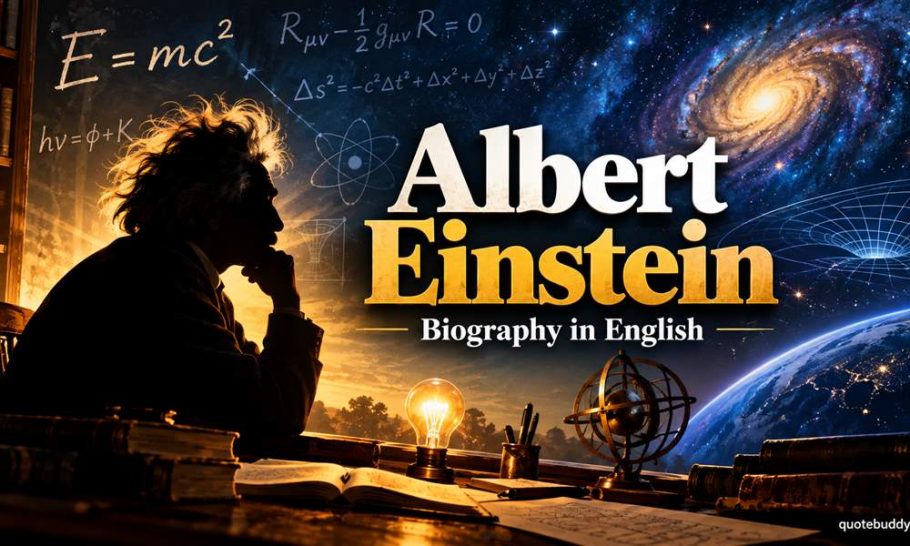
Biography of Albert Einstein — Albert Einstein is one of the most famous scientists in history. His theories of relativity changed how we understand space, time and gravity. His name is still a symbol of genius and curiosity.
- Early Life
- Student Years
- Miracle Year 1905
- General Relativity
- Nobel Prize
- Later Life and Legacy
Early Life
Einstein’s early years did not follow a simple school path. At the age of 15, he left school. This decision came before the later stages of his education, when he continued learning in other places. His childhood experience, including the compass story, showed his strong interest in understanding nature. The move from Ulm to Munich was also part of his family’s early journey. These experiences formed the beginning of a life that would later be closely connected with major ideas in physics.
Albert Einstein was born on 14 March 1879 in Ulm, Germany. His family later moved to Munich, where he spent part of his early life. One story from his childhood is about a compass. The movement of the compass needle made him curious about the hidden forces behind things he could see. This curiosity became an important part of his way of thinking. Instead of simply accepting what happened around him, Einstein wanted to understand why it happened and what ideas could explain the world.
Student Years
Einstein’s student years connected his early curiosity with his future work in physics. After studying in Aarau, he joined ETH Zurich in 1896 and graduated in 1900. A few years later, in 1902, he began working at the patent office in Bern. His position was technical expert third class. This job became part of the period just before his famous scientific work of 1905. His path from school to Aarau, then ETH Zurich, and finally the Bern patent office was an important sequence in his early career.
After leaving school at 15, Einstein continued his education in Aarau. His time there was followed by an important step in Zurich. In 1896, he entered ETH Zurich. He studied there and completed his graduation in 1900. These years gave him the educational background that came before his professional work. Aarau and ETH Zurich were important stages between his school years and his later career. By 1900, Einstein had completed this part of his education and was ready to move into working life.
Miracle Year 1905
Before this important year, Einstein was working at the patent office in Bern as a technical expert third class, a position he had held since 1902. In 1905, his four papers covered topics ranging from light and Brownian motion to relativity and E=mc2. The papers were published in Annalen der Physik. The photoelectric effect and light quanta paper later became especially important in relation to the Nobel Prize that Einstein received for the law of the photoelectric effect.
The year 1905 became a remarkable year in Einstein’s scientific work. He published four papers in Annalen der Physik. These papers dealt with the photoelectric effect and light quanta, Brownian motion, special relativity, and the relation written as E=mc2. Each paper addressed a different scientific question. Together, the four papers made 1905 a major year in Einstein’s work. His ideas from this period became closely associated with his name and with important developments in modern physics.
General Relativity
In 1919, an eclipse observation by Eddington became an important event connected with general relativity. Einstein had also predicted gravitational waves in 1916. Much later, in 2015, gravitational waves were detected. These events connected a prediction made during Einstein’s lifetime with a detection many years after his death. The history of general relativity therefore includes his work on the field equations in 1915, the 1919 Eddington eclipse observation, and the eventual detection of gravitational waves in 2015.
From 1907 to 1915, Einstein worked on general relativity. This work developed over several years and reached an important point in 1915, when he presented the field equations. General relativity became one of the major parts of his scientific legacy. It also led to predictions that could be tested through observations. The development from 1907 to 1915 shows that some of Einstein’s most important ideas were not completed in a single moment but took years of scientific work.
Nobel Prize
The Nobel Prize in Physics marked an important stage in Einstein’s career. The award was officially for 1921, while the announcement came in 1922. The reason given was the law of the photoelectric effect. This was the same area connected with one of his four major papers from 1905. Einstein’s scientific work covered several subjects, including Brownian motion, special relativity, E=mc2, and general relativity, but the Nobel recognition focused on the photoelectric effect law.
Einstein received the Nobel Prize in Physics for the law of the photoelectric effect. The prize was for 1921, although it was announced in 1922. This recognition was connected with the work he had published earlier on the photoelectric effect and light quanta. His 1905 paper on this subject was one of the four papers he published that year in Annalen der Physik. The Nobel Prize therefore became an important recognition of one specific part of his scientific work.
Later Life and Legacy
Einstein died on 18 April 1955 in Princeton. His life had included the 1905 papers, the development of general relativity from 1907 to 1915, the 1919 Eddington eclipse observation, and the Nobel Prize in Physics for the 1921 award. His prediction of gravitational waves came in 1916, while their detection happened in 2015. These dates show how ideas from his lifetime continued to be connected with scientific developments long after his death, forming an important part of his legacy.
In 1933, Einstein left Germany and went to the Institute for Advanced Study in Princeton. In 1939, he wrote a letter to Roosevelt. These events belong to the later part of his life after he had already produced his major scientific work. His career had moved across different stages, from Ulm and Munich to Aarau, ETH Zurich, the Bern patent office, and eventually Princeton. His later years continued to be part of the story of a scientist whose work had a lasting place in physics.
Quick Facts about Albert Einstein
- Born: 14 March 1879, Ulm, Germany
- Miracle year: 1905
- Famous equation: E = mc2
- Nobel Prize in Physics: 1921
- Died: 18 April 1955, Princeton
Timeline of Albert Einstein’s Life
- 1879 – Born in Ulm
- 1905 – Miracle year papers
- 1915 – General relativity
- 1921 – Nobel Prize in Physics
- 1933 – Moved to the United States
- 1955 – Passed away
Why Albert Einstein’s Story Matters Today
Einstein shows that curiosity and imagination can lead to great discoveries. Students can learn that even a person who struggled to get a job can change the world with ideas. His attitude towards questions is a lesson for every learner.
A Closer Look
Walter Isaacson’s Einstein: His Life and Universe is one of the most detailed biographies of the scientist. It explains both his personal life and his scientific work in simple language.
Recommended Book on Albert Einstein
If you want to read more about Albert Einstein, the book Einstein: His Life and Universe is a good place to start. You can buy it on Amazon:
Buy Einstein: His Life and Universe on Amazon
Frequently Asked Questions
Who was Albert Einstein?
He was a German-born physicist who developed the theory of relativity.
What is E = mc2?
It is an equation that shows the relationship between mass and energy.
Why did Einstein win the Nobel Prize?
He won it in 1921 for his work on the photoelectric effect.
Also read: Motivational Quotes in Hindi
